

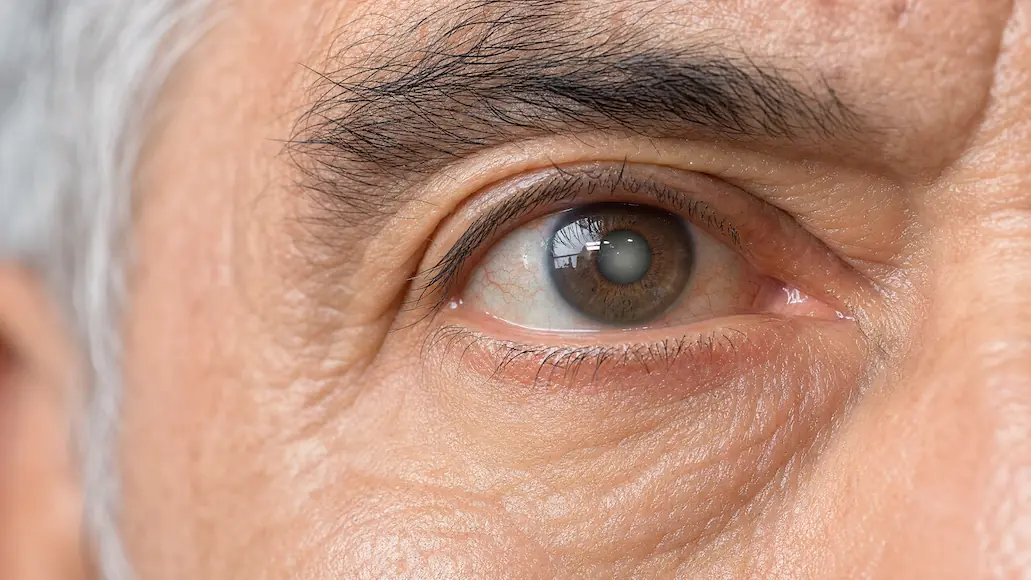
Cataract surgery swaps the cloudy natural lens inside your eye for a clear artificial lens. Mr Arthur Okonkwo, Consultant Ophthalmologist in Leeds, assesses you and carries out the operation himself. It takes 20 to 45 minutes with the eye numbed by local anaesthetic, and most people leave hospital that day.
It suits adults whose cataract now gets in the way of reading, driving or work, even with up-to-date glasses. His patients come from Yorkshire, the East Midlands and the North East to St James Laser Vision Clinic in Leeds.
He also leads NHS and private clinics at Leeds Teaching Hospitals NHS Trust. A specialist optometrist works alongside him to find out what you want from your sight after the lens change.
Considering Cataract Surgery in Leeds?
Book a cataract consultation with Mr Arthur Okonkwo to discuss your sight and what you want from it after surgery.
Prefer to call? 0113 460 1923, Monday to Friday, 9am to 5pm
What Is Cataract Surgery?
A cataract is clouding of the lens that sits behind your pupil.
Once your eye is numb, the surgeon makes a tiny opening in the cornea and in the thin bag around the lens, called the capsule. Sound waves (ultrasound) break the cloudy lens into pieces, and gentle suction removes them. A folded clear lens is then placed inside the same capsule, which holds it in position for life.
Symptoms Before and After Surgery: When to Get Help
Cataract symptoms creep in slowly, and the NHS list of cataract symptoms includes glare, halos and colours that look washed out. After surgery a different set of signs matters, because a few need the same-day attention of an eye team.
| Your symptom | Possible cause | What to do |
|---|---|---|
| Misty sight, faded colours, glare from headlights | A cataract (NHS) | See an optician, who can refer you |
| Sudden new floaters, flashes or a dark curtain over your sight | Detached retina (NHS) | Get help from NHS 111 or the eye team today |
| Pain, redness or blurring getting worse after surgery | Infection or inflammation inside the eye (Moorfields) | Contact the eye team the same day, or go to A&E |
| Sight clouding again months or years later | Posterior capsule opacification (NHS) | Book a review with Mr Okonkwo |
Conditions Mr Okonkwo Treats with Cataract Surgery
- Age-related cataract: the commonest type.
- Cataract with astigmatism: the front of the eye curves more steeply one way than the other. A toric implant can correct some of it in the same operation.
- Cataract with short or long sight: the new lens power is chosen to reduce your glasses prescription. A clear lens swapped for this reason alone is refractive lens exchange.
- Cataract with corneal disease such as Fuchs dystrophy: the health of the cornea shapes the surgical plan. His corneal transplantation page explains the graft options.
- Cloudy sight after earlier cataract surgery: usually capsule clouding, cleared in clinic by laser YAG capsulotomy.
Treatment Options: Choosing Your Lens Implant
The operation is the same for every lens. What differs is how the artificial lens focuses. NICE guideline NG77 (recommendation 1.4.2) does not offer multifocal lenses in NHS cataract surgery, so those are a private choice.
Monofocal Lens: One Clear Focus
A monofocal lens has a single point of focus, usually set for distance. It suits most people, including those with other eye conditions. You will usually need reading glasses afterwards. Surgery takes 20 to 45 minutes as a day case (NHS). Its risks are those in the table below. The main one is a 1 in 1,000 chance of severe, lasting sight loss in that eye (Moorfields).
Monovision: Distance in One Eye, Near in the Other
Two monofocal lenses are set differently, one for distance and one for arm’s length. Moorfields suggests it for people with no strong preference who saw well before the cataract formed. The time and day-case stay are the same. Some people take a few weeks to adapt, and most still wear glasses for some tasks.
Toric Lens for Astigmatism
A toric lens has astigmatism correction built in and is turned to a set angle inside the eye. At Moorfields it may be available on the NHS when astigmatism is 1.75 dioptres or more. The stay is still a day case. The lens can rotate, and Moorfields says a second operation may then be needed to turn it back.
Multifocal and Extended-Range Lenses
These lenses spread focus over more than one distance to cut down on reading glasses. His practice page lists multifocal and extended-range types. The RCOphth says multifocal lenses cause more halos and glare than monofocal ones. About 1% of people cannot adapt and choose a lens exchange. They are not suitable for every eye.
Not Sure Which Lens Implant Is Right for You?
Book an appointment to find out whether your cataract is ready for surgery and which lens fits the way you use your eyes. Bring your glasses and any recent optician report.
Prefer to call? 0113 460 1923, Monday to Friday, 9am to 5pm
Why Patients Choose Mr Okonkwo for Cataract Surgery
- Hospitals: NHS and private clinics he runs within Leeds Teaching Hospitals NHS Trust, plus private consultations at St James Laser Vision Clinic.
- Qualifications: MBBS with Distinction from Newcastle University in 2014. He also holds an MRes in Transplantation with Distinction and FRCOphth. Further awards are a laser and refractive surgery certificate from the RCOphth (CertLRS) and an Ulster University postgraduate diploma, with Distinction, covering cataract and refractive surgery. He has a Postgraduate Certificate in Medical Education too (award years [to confirm]).
- Training: academic clinical posts in Leeds and Manchester. He then completed two fellowships, at Moorfields Eye Hospital, London, and The Royal Victorian Eye and Ear Hospital, Melbourne.
- Membership: Fellow of the Royal College of Ophthalmologists.
- Research: corneal disease, transplantation and new surgical methods, covered in over 30 peer-reviewed papers and funded by more than 300,000 pounds of international grants and prizes.
- Teaching: Honorary Senior Lecturer at the University of Leeds, training medical students and fellows in ophthalmology.
Will I Still Need Glasses, and Should Both Eyes Be Done Together?
| Lens plan | Glasses you are likely to need | Main trade-off |
|---|---|---|
| Monofocal for distance | Reading glasses | Fewest optical side effects (RCOphth) |
| Monovision | Glasses for long reading or night driving | A few weeks to adapt (Moorfields) |
| Toric | Usually reading glasses | Lens can rotate (Moorfields) |
| Multifocal or extended range | Fewer, for some tasks | More halos and glare (RCOphth) |
Your Cataract Surgery Pathway, Step by Step: Referral, Appointment, Lens Plan and Theatre Day
- Referral: you can book privately without a referral, though notes from your GP or optician give useful background. On the NHS, the GP or optician refers you to Leeds Teaching Hospitals.
- First consultation: at St James Laser Vision Clinic, with time to talk through your eye history before the examination and in-clinic scans. Drops that enlarge the pupil act within 20 to 30 minutes. Your sight stays blurred and glare-sensitive for some hours, so do not drive.
- Measurements: optical biometry measures the length of your eye to set the lens power (NICE 1.3.1). Moorfields asks for soft contact lenses out for 1 week and rigid ones for 2 weeks first.
- Review and decision: you go through lens options, risks and the effect on daily life with Mr Okonkwo and the optometrist (NICE 1.2.1). You decide whether to go ahead.
- Treatment day: pre-operative checks, local anaesthetic and an operation of 20 to 45 minutes (NHS). You rest briefly, receive written aftercare and go home the same day.
- Follow-up: a review to check healing, then plans for the second eye if it also has a cataract (NICE 1.6.2).
Recovery and Risks After Cataract Surgery
The NHS says you will use eye drops for about 4 weeks, and your eye may ache for a few days. Moorfields says it can feel scratchy for 7 to 10 days, feels normal after 2 weeks and takes about 6 weeks to heal fully. You wear a plastic shield at night for about a week.
Serious problems are uncommon, but they matter. 1 in 1,000 risk of severe, permanent sight loss in the operated eye. About 1 in 100 people need more surgery, and 1 in 20 have a lesser problem that is often handled during the operation.
About 1 in 10 people later need laser for a clouded capsule, according to the same leaflet. For a toric lens, rotation can mean a second operation. For multifocal lenses, the RCOphth gives about 1% who choose an exchange.
| Treatment | Hospital stay | Example risk |
|---|---|---|
| Cataract surgery with a monofocal lens | Day case, home the same day (NHS) | 1 in 1,000 risk of severe, permanent sight loss in that eye (Moorfields) |
| Any cataract operation | Day case (NHS) | About 1 in 100 need further surgery (Moorfields) |
| Toric lens | Day case (NHS) | Lens rotation, sometimes a second operation (Moorfields) |
| Multifocal lens | Day case (NHS) | Halos and glare, about 1% have the lens exchanged (RCOphth) |
| Both eyes in one visit | Day case (Moorfields) | About 1 in 250,000 risk of severe sight loss in both eyes (Moorfields) |
| Months or years later | Clinic laser, no stay | About 1 in 10 need laser for capsule clouding (Moorfields) |
Milestones for the first 6 weeks, drawn from the NHS and Moorfields, are set out below.
| When | What to expect | Source |
|---|---|---|
| Day 1 | Sight blurry for a few hours, eye covered or shielded | NHS |
| Days 1 to 4 | Driving only once you meet the DVLA standard, often after 3 to 4 days | Moorfields |
| Weeks 1 to 2 | No swimming, eye make-up or heavy lifting | NHS, Moorfields |
| Weeks 4 to 6 | Drops finish, eye fully healed, glasses checked | NHS, Moorfields |
Where Mr Okonkwo Sees Cataract Patients in Leeds
Consultations are held at St James Laser Vision Clinic, Floor 4 of the Gledhow Wing, inside St James’s University Hospital. Phone 0113 460 1923 between 9am and 5pm, Monday to Friday, to arrange a visit.
| Location | Address |
|---|---|
| St James Laser Vision Clinic | Floor 4, Gledhow Wing, St James’s University Hospital, Beckett Street, Leeds LS9 7TF |
| NHS clinics, Leeds Teaching Hospitals NHS Trust | By referral from your GP or optician |
FAQs About Cataract Surgery
Is cataract surgery major surgery?
It is a day-case operation under local anaesthetic, usually 20 to 45 minutes long (NHS). It is still surgery inside the eye. Moorfields gives a 1 in 1,000 risk of severe, permanent sight loss.
Will I feel anything while the lens is changed?
You are awake but should feel no pain once the eye is numb. Moorfields says you may notice pressure, cold water or coloured lights. Sedation can be discussed if you feel anxious.
How long is the recovery after a lens implant?
The NHS says sight may take several days to improve. Moorfields says the eye feels normal after 2 weeks and heals fully by about 6 weeks. The NHS asks you to avoid swimming and heavy lifting until your doctor says otherwise.
When can I drive again after cataract surgery?
When you can read a number plate from 20.5 metres with both eyes open, the DVLA standard Moorfields quotes. That normally takes 3 to 4 days. Someone else must drive you home after surgery.
Can a cataract come back once the lens is removed?
No. The cloudy lens is gone. The capsule behind the new lens can cloud later in about 1 in 10 people (Moorfields), and a short clinic laser clears it. See laser YAG capsulotomy.
Can both eyes be operated on in one visit?
Sometimes. Moorfields offers it to suitable people, with a 1 in 250,000 risk of severe sight loss in both eyes. Many people still choose separate days so the first eye can guide the second lens.
Are there alternatives to an operation?
An updated prescription and good lighting can help for a time (NHS). No drops dissolve a cataract. If you are happy with your sight, waiting is usually safe, according to Moorfields.
How much does private cataract surgery cost?
Fees are not published online. The practice gives you a written quote once your lens type is agreed, because the lens affects the price.
Do I need a GP letter to see Mr Okonkwo?
Not always. A GP or optician letter gives useful background, but you can book a private consultation directly. NHS appointments at Leeds Teaching Hospitals need a GP or optician referral.
When can I go back to work and the gym?
Moorfields says many people return to work the day after, depending on the job. Light exercise is usually fine within 2 or 3 days. Avoid swimming for 2 weeks.
When should my glasses be checked again?
Moorfields suggests seeing your own optician about 4 to 6 weeks after the operation. If both eyes need surgery, you may wait until the second eye has settled.
Quick Info
What is it?
Removing the cloudy lens and fitting a clear artificial lens (NHS)
Who is it for?
Adults whose cataract affects daily life, not just a chart score (NICE NG77)
How long does it take?
Usually 20 to 45 minutes (NHS)
Hospital stay
Day case: home the same day, with someone else driving (NHS)
Recovery
Drops for about 4 weeks, fully healed by about 6 weeks (NHS, Moorfields)
Ready to Get Started?
Book a consultation to discuss your symptoms and treatment options.
Book a Cataract Surgery Consultation with Mr Arthur Okonkwo
Book an appointment to find out whether your cataract is ready for surgery and which lens fits the way you use your eyes. Bring your glasses and any recent optician report.
- Phone: 0113 460 1923, Monday to Friday, 9am to 5pm
- Online: request a time on the appointment booking form, or write to the Leeds practice through its contact page
More on how safe cataract surgery is, the recovery timeline and when cataracts should be removed is on the blog. Every procedure he offers is on the treatments page.
For worsening pain, redness or blurred sight after surgery, contact the eye team the same day, or your GP, optician or NHS 111. Sudden loss of sight, or sepsis signs like confusion and mottled skin, need 999 or A&E straight away.