

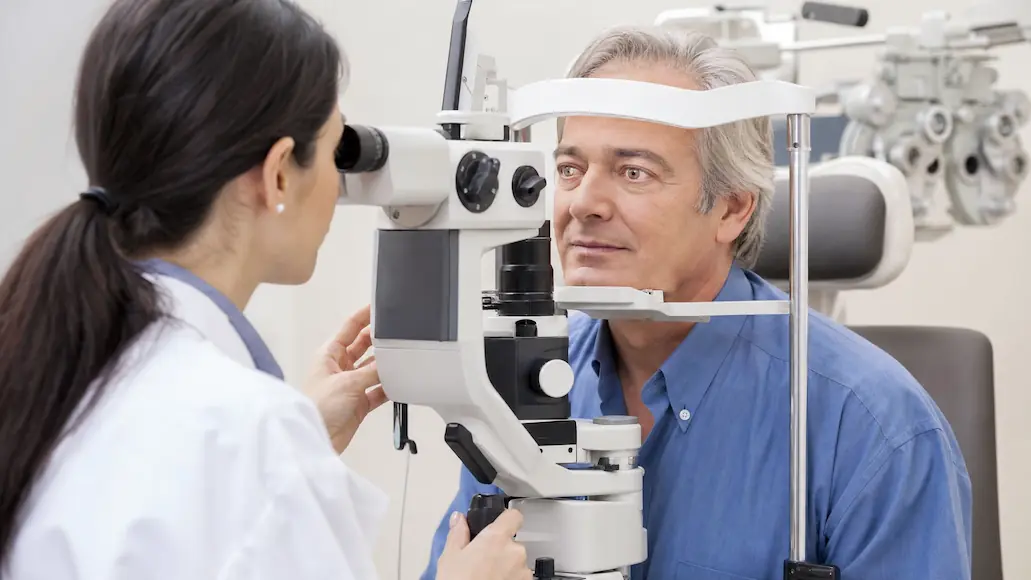
In glaucoma, the optic nerve that carries sight to the brain is damaged, most often because fluid pressure inside the eye is too high. It is most common after 50, and since lost sight cannot be restored, treatment protects what remains. Mr Arthur Okonkwo, Consultant Ophthalmologist, lowers pressure with eye drops or laser at his private clinic, St James Laser Vision Clinic in Leeds.
His Leeds cornea, cataract and refractive procedures are on the treatments page. Early on there are usually no symptoms, and an optician often spots the first signs at a routine test.
Book a Glaucoma Assessment
Book a consultation with Mr Okonkwo in Leeds to discuss your eye pressure and test results.
Prefer to call? 0113 460 1923, Monday to Friday, 9am to 5pm
What Is Glaucoma?
A watery fluid called aqueous is made at the front of the eye and drains out through a fine mesh, the trabecular meshwork, and when it drains poorly, pressure rises and strains the optic nerve. The optic nerve can be damaged even when pressure is normal.
Loss starts at the edges of your vision and develops slowly over years, and NHS diagnosis, treatment and reviews follow NICE guideline NG81. Raised pressure without nerve damage is treated from 24 mmHg if your sight is at risk within your lifetime.
Sudden Eye Pain, Haloes or Worsening Sight: When to Get Urgent Help
Most cases cause no pain, except a sudden attack when the drainage angle closes. Severe eye pain, redness, coloured haloes round lights, headache or vomiting mean 999 or A&E, with someone else driving.
| Your symptom | Possible cause | What to do |
|---|---|---|
| Sudden severe eye pain, red eye, haloes, headache or vomiting | Acute angle closure | Call 999 or go to A&E; do not drive |
| Eye sorer, redder or blurred in the days after SLT | Inflammation or a pressure rise | Call the clinic on 0113 460 1923 the same day |
| Pain, redness or falling vision after drainage surgery | Possible infection | Same-day eye assessment, or NHS 111 out of hours |
| Side vision that seems patchy or narrower over months | Possible optic nerve damage | See your optician or GP for a referral |
Conditions Mr Okonkwo Treats: Raised Pressure and Its Main Types
- Ocular hypertension: raised pressure with a healthy optic nerve. SLT or drops are offered from 24 mmHg when sight is at risk.
- Primary open-angle type: the commonest UK form, developing slowly over many years.
- Normal-tension type: nerve damage even though pressure stays in the normal range.
- Narrow-angle or angle-closure type: the iris blocks drainage, and laser iridotomy puts a pinhole-sized opening in the iris.
- Pseudoexfoliation and pigmentary types: secondary forms caused by another eye condition, and pigment dispersion rules out SLT as a first step.
Treatment Options to Lower Eye Pressure: Drops, Laser and Surgery
All 3 options lower pressure, and none brings back lost sight. Mr Okonkwo sets your target pressure, the level needed to stop further damage, from your test results.
Pressure-Lowering Eye Drops
Drops either reduce the fluid the eye makes or help it drain, with no hospital stay. A prostaglandin-type drop usually comes first, then a beta-blocker or another class if needed. Between 50 and 60% of people using glaucoma eye drops also have dry eye, which dry eye procedures can ease.
Selective Laser Trabeculoplasty (SLT)
A laser aimed at the drainage mesh helps fluid flow out more easily, and is the usual first choice for newly diagnosed open-angle disease or raised pressure, unless pigment dispersion is present. It takes about 10 minutes per eye in clinic, though the visit can last a few hours. Pressure can rise shortly afterwards, so it is checked before you go home.
Drainage Surgery
A trabeculectomy makes a new channel that lets fluid collect in a small blister, called a bleb, under the eye surface. It is used for later-stage disease, or when drops and laser have not controlled pressure. It takes 1 to 2 hours under local anaesthetic, with several weeks to recover.
Concerned About Your Eye Pressure?
Book if an optician has found raised pressure, a suspicious optic nerve or a field defect, and bring the referral letter and your drops list to Leeds.
Prefer to call? 0113 460 1923, Monday to Friday, 9am to 5pm
Why Patients Choose Mr Okonkwo for Pressure Checks and Care
- NHS consultant: leads NHS and private eye clinics within Leeds Teaching Hospitals NHS Trust.
- College fellowship: FRCOphth..
- Postgraduate study: an MRes in Transplantation with Distinction, plus awards in cataract and refractive surgery and in medical education.
- Training: academic training across Leeds and Manchester, and fellowship years at Moorfields Eye Hospital and in Melbourne.
- Teaching: holds an honorary senior lectureship at the University of Leeds.
- Research: more than 30 peer-reviewed articles, plus international research grants and prizes.
Driving, Your Licence and the DVLA
You must tell DVLA if glaucoma affects both eyes, or if only one eye sees and that eye is affected. Failing to report it can lead to a fine of up to 1,000 pounds.
For a car licence you need to read a number plate at 20 metres, with no double vision and a normal visual field. DVLA may send you for a free eyesight test, which must include an Esterman visual field test. Your clinic field results give an early idea of where you stand.
Do not drive on the day of SLT, or after dilating drops. With NHS or private diagnosis and treatment early, losing sight is rare. His blog on blindness risk covers this in more depth.
Alternatives: Watchful Monitoring, Switching Drops or No Treatment
Not everyone with raised pressure needs treatment. Below 24 mmHg, or where sight is not expected to be at risk in your lifetime, regular optician checks are enough.
- Watchful monitoring: pressure, nerve and field checks without treatment, if your risk is low and pressure stays under 24 mmHg.
- Switching drops: another class or preservative-free drops if side effects are a problem.
- Declining treatment: your choice, though it raises the risk of losing vision. A pressure check within 1 to 4 months is advised.
Step by Step Through Your Care: Referral, First Appointment and Reviews
- Referral: for NHS care your GP or optician refers you, while privately a letter helps but you can book without one.
- First appointment: up to 90 minutes, covering your general health, family history and eye symptoms. Pupil drops blur sight for hours, so get a lift to St James.
- Tests: eye pressure, a visual field test, an OCT scan of the optic nerve and gonioscopy, a lens check of the drainage angle. After laser vision correction, readings can be low, so mention it.
- Your plan: Mr Okonkwo sets a target pressure and talks through drops or SLT. His patient leaflet summarises the options.
- Laser day and reviews: SLT takes about 10 minutes per eye, with a pressure check before home and a first review 2 to 3 months later. Reviews are lifelong, every 1 to 18 months depending on control and risk.
Recovery and Risks After Drops, Laser or Surgery
Drops need no recovery time, but they must go in every day. Wait at least 5 minutes between different drops. After SLT, expect a few hours of blur and a few days of soreness.
SLT first lowers pressure for nearly 8 out of 10 people. On average six years later, more than 7 in 10 still have good pressure without other treatment. After a drainage surgery the eye needs several weeks, and glasses should not be changed for 3 months.
| Treatment | Hospital stay | Example risk |
|---|---|---|
| Eye drops | None | Dry eye in 50 to 60% of people with the condition |
| SLT | Home the same day, after a pressure check | Pressure rise shortly afterwards, treated before you leave |
| Trabeculectomy | Home the same day or the next | Infection, and several weeks to recover |
Where Mr Okonkwo Sees Patients in Leeds
Private appointments take place at St James Laser Vision Clinic, Leeds. NHS patients are seen in his clinics at Leeds Teaching Hospitals NHS Trust. The venue for SLT is [to confirm].
| Location | Address |
|---|---|
| St James Laser Vision Clinic | Floor 4, Gledhow Wing, St James’s University Hospital, Beckett Street, Leeds LS9 7TF |
To book or ask a question, phone 0113 460 1923 between 9am and 5pm on a weekday.
FAQs About Eye Pressure, Drops and Laser
Is drainage surgery for raised eye pressure a major operation?
Yes, by comparison with drops or laser. A trabeculectomy takes 1 to 2 hours under local anaesthetic, and the eye needs several weeks to recover.
How long does recovery from SLT take?
Usually a day for everyday tasks, with soreness for a few days. The pressure result is checked 2 to 3 months later.
Can I keep driving after diagnosis?
Often, yes, if you meet the standard. DVLA must be told when both eyes are affected, or when the affected eye is the only one that sees.
Can high pressure come back after SLT?
Yes. The benefit usually lasts a few years, then wears off. A second SLT is possible if the first one worked.
Is there an alternative to daily drops?
SLT can delay the need for drops or reduce how many you use. It does not remove the chance you will need them later.
Could raised eye pressure cost me my sight?
Rarely, especially when found and treated early. Lost vision cannot be recovered, so reviews every 1 to 18 months matter.
Does it run in families?
It can. A parent or sibling with it raises your risk. So does being over 50 or having a Black African, Caribbean or Asian family background.
How often will my eyes be checked?
It depends on your pressure control and risk: every 1 to 2 months when pressure is high and worsening, up to 12 to 18 months when stable.
Can I have SLT if my drainage angles are narrow?
Usually not, as SLT may be unsuitable for angle-closure or late-stage disease. Laser iridotomy, a small opening in the iris, is used for narrow angles instead.
Quick Info
What is it?
Optic nerve damage, usually from fluid pressure building inside the eye
Who is it for?
Anyone referred with raised pressure, a suspicious optic nerve or patchy side vision
How long does it take?
First assessment up to 90 minutes; SLT laser about 10 minutes per eye
Hospital stay
None for drops or SLT; drainage surgery: home the same day or next
Recovery
Normal activities the day after SLT; several weeks after drainage surgery
Ready to Get Started?
Book a consultation to discuss your symptoms and treatment options.
Book a Pressure and Optic Nerve Assessment with Mr Arthur Okonkwo
Book if an optician has found raised pressure, a suspicious optic nerve or a field defect, and bring the referral letter and your drops list to Leeds.
- Phone: 0113 460 1923, weekdays from 9am to 5pm
- Online: book a pressure assessment, or send a short enquiry
A sudden painful red eye with haloes or vomiting needs 999 or A&E, without driving. For worsening soreness after treatment, phone the clinic, your GP or NHS 111. Sepsis signs need 999.